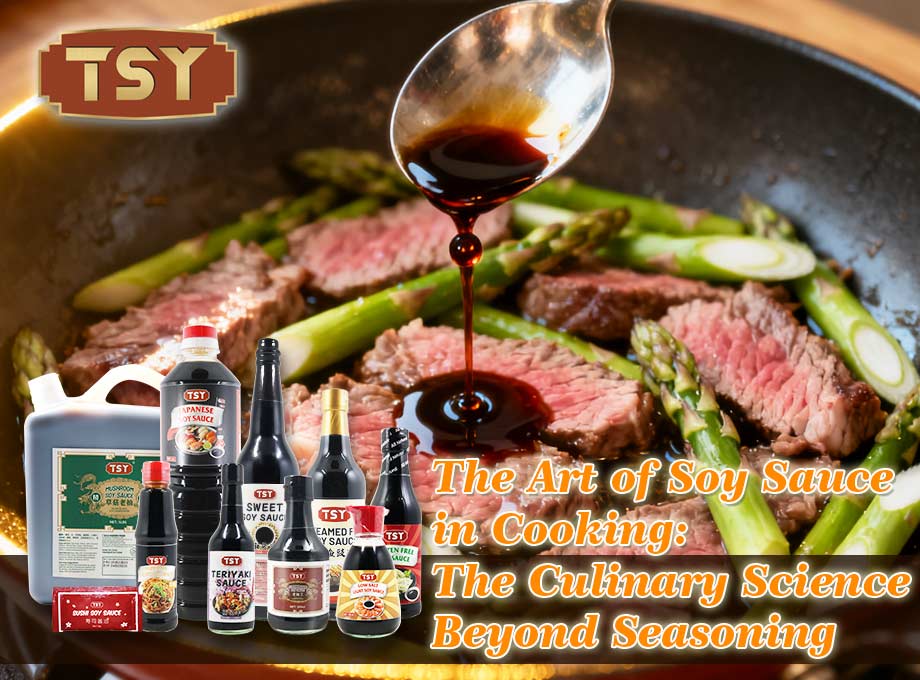
The Art of Soy Sauce in Cooking: The Culinary Science Beyond Seasoning
When a drop of soy sauce falls into a searing hot wok, instantly releasing its unique aroma, this marks not just the beginning of a seasoning process, but a symphony of complex physical and chemical reactions. Soy sauce holds a place in East Asian kitchens akin to the central role of salt in Mediterranean cooking—it is not merely a source of saltiness, but also a catalyst for flavor, color, texture, and chemical transformations. Modern food science reveals that this seemingly simple dark liquid holds culinary wisdom that extends far beyond mere seasoning.
I. The Multidimensional Role of Soy Sauce: Compound Functions Beyond Saltiness
1. The Three-Dimensional Project of Flavor Construction
High-quality soy sauce contains over 300 volatile compounds that collectively build its complex flavor profile. Key components include:
4-Hydroxy-2 (or 5)-ethyl-5 (or 2)-methyl-3(2H)-furanone (HEMF): Provides a unique caramel-like aroma.
4-Ethylguaiacol (4-EG): Contributes smoky, spice-like notes.
Ethyl Acetate: Imparts fruity and sweet aromas.
Amino Acids and Peptides: Produce a lasting umami and rich, mellow sensation.
Interestingly, adding these flavor compounds at different stages of cooking yields markedly different results. Experimental data show that adding soy sauce at the beginning of cooking promotes Maillard reactions and Strecker degradation under high heat, generating more roasted and nutty flavors. Adding it towards the end better preserves its umami and floral/fruity aromas.
2. The Magic of Color: More Than Just Coloring
The color of soy sauce originates from two main processes:
Research indicates that soy sauce achieves its best coloring effect at a pH of 4-6, explaining why its color changes in acidic environments (like when vinegar or tomato is added). More surprisingly, the coloring power of different soy sauces can vary by up to 300%, depending on their amino acid content, reducing sugar concentration, and brewing time.
3. Texture Regulation: The Invisible Culinary Assistant
Polysaccharides, peptides, and organic acids in soy sauce can:
Bind with proteins to form a protective layer, preventing excessive dehydration in meats.
Interact with starch molecules, affecting the viscosity and gloss of dishes.
Act as emulsifiers to promote oil-water mixing, making sauces more stable.
II. Temperature and Time: The Kinetics of Soy Sauce Reactions
Chemical Changes Across Temperature Gradients
| Temperature Range | Primary Reactions | Flavor Changes | Optimal Applications |
| 60-80°C | Enzymatic reactions continue | Umami enhances | Low-temperature cooking, marinating |
| 100-120°C | Maillard reaction accelerates | Caramel, nutty aromas become prominent | Stir-frying, pan-frying |
| 130-150°C | Strecker degradation | Smoky, roasted flavors form | Grilling, oven roasting |
| >160°C | Pyrolysis reactions | May produce bitter compounds | Use with caution |
Flavor Evolution Over Time
Experiments from Japan's Fermentation Research Institute show that the flavor evolution of soy sauce during cooking follows a non-linear pattern:
0-3 minutes: Rapid release of volatile aromatic compounds.
3-10 minutes: Gradual formation of Maillard reaction products.
10-30 minutes: Recombination of flavor compounds, reaching equilibrium.
>30 minutes: Partial decomposition of some flavor compounds, while mellowness increases.
III. The Molecular Dialogue Between Soy Sauce and Ingredients
The Intimate Partner of Proteins
When soy sauce meets protein, three key interactions occur:
Surface Binding: Organic acids and amino acids in soy sauce bind to the protein surface, altering its isoelectric point and affecting water retention.
Osmotic Effect: Small molecules (like amino acids, salt) penetrate the protein interior, changing its structure and flavor.
Cross-linking Reactions: Under heating conditions, reducing sugars in soy sauce cross-link with proteins, forming a more stable structure.
Experiments show that meats marinated in soy sauce can have a 15-25% lower moisture loss after cooking, precisely due to the protective barrier formed by these interactions.
The Transformation Catalyst for Starch
Organic acids (lactic acid, acetic acid) in soy sauce can:
Partially hydrolyze starch molecules, broadening their gelatinization temperature range.
Form complexes with amylose, delaying starch retrogradation.
Provide reducing sugars to participate in caramelization reactions, adding gloss to dishes.
The Flavor Carrier for Fats
As amphiphilic molecules, peptides and amino acids in soy sauce are excellent emulsifiers that can:
Reduce oil-water interfacial tension, forming stable emulsions.
Carry fat-soluble flavor compounds, enhancing flavor release.
Inhibit fat oxidation, extending the flavor stability of dishes.
IV. Scientific Application in Culinary Techniques
1. The Art of "Bao Xiang" (fragrance explosion)
When hot oil (around 180°C) meets soy sauce containing water, an intense Leidenfrost effect occurs—water droplets form a vapor layer upon contact with the hot surface, causing them to levitate and burst, atomizing and diffusing flavor compounds. The key techniques professional chefs master are:
Oil temperature should be 20-30°C below its smoke point.
Avoid excessive soy sauce to prevent a sudden temperature drop.
Stir-fry rapidly to promote even heating.
2. The Chemistry of "Hong Shao" (red-braising)
The "red and glossy" color of red-braised dishes comes from the synergy of three reactions:
Maillard Reaction: Provides the base brown color.
Caramelization Reaction: Adds reddish tones.
Soy Sauce Pigment Stabilization: Most stable under slightly acidic conditions (pH 5.5-6.0).
Scientific experiments show that adding soy sauce in stages creates richer color layers: the first addition (early braising) produces the base color, the second (mid-braising) enhances color depth, and the third (sauce reduction) adds surface gloss.
3. The Osmotic Balance in the Marinating Process
Soy sauce marinating follows Fick's laws of diffusion. Insights for practice include:
Properly diluting soy sauce can improve osmotic efficiency.
For every 10°C increase in temperature, diffusion speed increases by 1.5-2 times.
Meat fiber direction affects penetration depth (penetration is about 30% faster along the grain than across it).
V. Integration with Modern Cooking Technologies
1. Application of Soy Sauce in Sous-vide Cooking
In the low-temperature cooking environment of 55-65°C, soy sauce exhibits unique advantages:
Enzymatic reactions continue gently, developing flavors mildly.
Protein denaturation is slow, retaining more juices.
Can form unique gel textures.
Recommended method: Vacuum-seal ingredients with soy sauce and process in a 60°C water bath for 1-4 hours.
2. Soy Sauce from a Molecular Gastronomy Perspective
Spherification: Using the reaction between sodium alginate and calcium ions to form soy sauce "caviar" pearls.
Foaming: Adding soy lecithin and using a homogenizer to create stable foam.
Low-Temperature Concentration: Vacuum concentration below 40°C to preserve volatile aromatic compounds.
3. Ultrasound-Assisted Extraction
Ultrasound (20-40 kHz) can:
Disrupt cell structures, accelerating the release of flavor compounds.
Promote emulsification, creating a finer texture.
Achieve flavor changes similar to cooking at room temperature.
VI. The Scientific Balance of Health and Safety
1. Controlling Acrylamide Formation
Asparagine and reducing sugars in soy sauce may form acrylamide under high heat. Control strategies include:
Minimal generation when cooking below 120°C.
Adding small amounts of acidic substances (e.g., lemon juice) can inhibit its formation.
Choosing soy sauce with longer brewing times (precursor substances for acrylamide are already consumed).
2. The Art of Sodium-Potassium Balance
Although soy sauce is high in sodium, its potassium content is also significant (about 400-500mg/100ml). Smart usage techniques:
Partially replacing salt with soy sauce can increase potassium intake.
Pairing with high-potassium ingredients (e.g., potatoes, bananas) achieves electrolyte balance.
When using reduced-sodium soy sauce, compensate for flavor by adding natural umami substances (e.g., shiitake mushrooms, kelp).
3. Preserving Antioxidant Activity
Polyphenols in soy sauce are easily degraded during cooking. Protective measures:
Avoid prolonged high-temperature heating.
Pair with ingredients rich in Vitamin C for an antioxidant synergistic effect.
Add towards the end of cooking to shorten heat exposure time.
VII. Chemical Interpretation of Regional Culinary Wisdom
1. The Formation of "Guo Ba" (crispy rice crust) in Cantonese Clay Pot Rice
Soy sauce plays a role far beyond seasoning in clay pot rice:
Penetrates rice pores, lowering local water activity.
Forms complexes with starch, promoting the crisping of the rice crust.
Sugars participate in caramelization, producing a unique aroma.
2. The Mirror-like Gloss of Japanese Teriyaki Sauce
The gloss of teriyaki sauce comes from the ordered arrangement of protein-polysaccharide complexes on the surface, involving soy sauce's:
Amino acids providing reactive groups.
Reducing sugars participating in the Maillard reaction.
Viscous substances forming a continuous film layer.
3. The Tenderizing Mechanism in Korean Barbecue
Soy sauce plays a triple role in Korean marinade (Yangnyeom):
Organic acids partially hydrolyze muscle fibers.
Salt alters protein charge, improving water retention.
Sugars form an appealing caramelized crust during grilling.
VIII. The Future Science of Soy Sauce in Cooking
1. Precision Fermentation Technology
Through metabolic engineering regulation, future production may yield:
Customized soy sauce with specific flavor profiles.
Healthier products that are low in sodium and high in umami.
Professional kitchen-use soy sauce with enhanced cooking stability.
2. Integration with Smart Cooking Systems
Based on a database of soy sauce reaction kinetics, smart kitchen appliances will be able to:
Automatically adjust temperature and addition timing.
Predict the final flavor and color of dishes.
Optimize usage based on individual health needs.
3. Sustainable Brewing Innovations
Utilizing by-products from the food industry as raw materials.
Developing low-temperature, low-energy brewing processes.
Creating reusable brewing systems.
Conclusion: The Universe in a Bottle of Soy Sauce
From a soybean to a bottle of amber liquid, from simple saltiness to a symphony of over three hundred flavor compounds, the journey of soy sauce in cooking is an epic of condensed food science. It teaches us not only seasoning techniques but also a culinary philosophy of understanding food, respecting process, and mastering balance.
In the modern kitchen, when we re-examine this ancient condiment, we see no longer just a simple dark liquid, but a complex chemical system, a cultural vessel, a bridge connecting tradition and innovation. Each well-timed addition is a precise control of temperature, time, concentration, and reaction; every successful dish is a harmonious application of soy sauce's multidimensional functions.
As the French chemist Lavoisier said, "In nature, nothing is created, nothing is lost, everything is transformed." The art of soy sauce in cooking is the perfect example of this transformation—it turns the simplicity of soybeans into the richness of flavor, the wait of time into the accumulation of depth, and the action of heat into the bloom of aroma.
In this era that pursues speed and convenience, understanding and respecting the science of soy sauce in cooking may allow us to rediscover the value of slowness, the meaning of process, and the wonder of transformation. For truly great cooking is never merely a pile-up of techniques, but a profound understanding of the essence of ingredients and a reverence for the process of transformation. And a bottle of high-quality soy sauce is the best footnote to this understanding and reverence.
If you are interested in wholesale of sauces and noodles, you can leave a comment below, send us a message through our website, or connect with us on social media. Please feel free to contact us TSY Food for a good price.