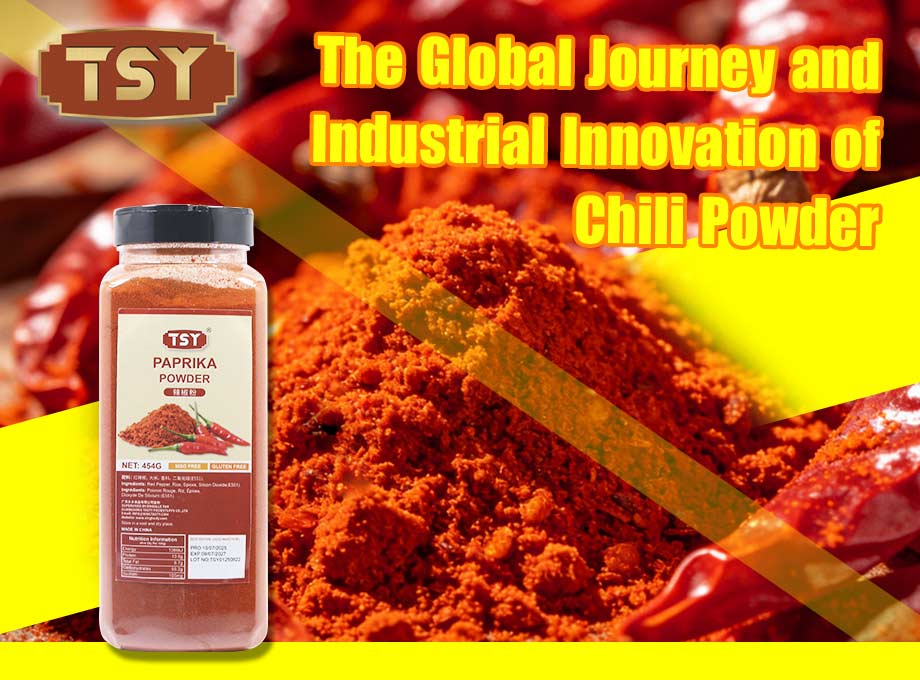
The Global Journey and Industrial Innovation of Chili Powder
When a spoonful of chili powder is sprinkled into a boiling hotpot or blended into Mexican salsa, that fiery red hue ignites far more than just taste buds. From ancient cultivation in the Andes Mountains to a staple in kitchens worldwide today, the journey of chili powder spans five centuries of geographical discovery and three industrial revolutions, constituting a condensed history of global trade, agricultural evolution, and food industry innovation. Today, this seemingly ordinary red powder is the product of a precise symphony involving genetic sequencing, supercritical extraction, global supply chains, and digital agronomy.
Chapter 1: The Global Journey – From New World Sacred Plant to World Spice
The epic of chili powder begins in the Americas. Archaeological evidence indicates that in the Tehuacán Valley of Mexico, chili peppers (Capsicum) were domesticated over 6,000 years ago. For ancient Mesoamerican civilizations, chili was not only food but also one of the "Three Sisters" of life alongside maize and beans, used in rituals, as medicine, and even as currency. In 1493, during Columbus's second voyage, chili seeds were brought back to Spain. Mistaking them for a spicier variety of pepper, he named them "Chili Pepper."
1.1 The Red Routes of the Age of Discovery
The spread of chili peppers maps onto early globalization: Portuguese traders carried them along the West African coast to Goa, India, and then via the Malacca trade hub to China, Japan, and Southeast Asia; the Spanish introduced them to the Philippines via the Manila Galleon trade, radiating throughout East Asia. By the late 16th century, chili peppers had taken root in the mountainous regions of southwestern China, profoundly reshaping the essence of Sichuan and Hunan cuisines. In India and Southeast Asia, they merged with local spices, giving birth to signature flavors like curry and tom yum. The speed of this dissemination was unprecedented in agricultural history, facilitated by the plant's remarkable adaptability—thriving from arid highlands to tropical rainforests.
1.2 The Formation of Diverse Flavors
Global migration spurred astonishing diversity. Currently, cultivated chili peppers worldwide primarily originate from five domesticated species: Capsicum annuum constitutes the majority of global production, ranging from bell peppers to Mexican jalapeños; Capsicum chinense, despite its name, actually originated in the Amazon and is known for "ghost peppers" like the Carolina Reaper, with Scoville Heat Units (SHU) exceeding 2.2 million; Capsicum frutescens is the basis for Tabasco sauce; Capsicum baccatum is popular in the South American Andes; and Capsicum pubescens, with its black seeds, is adapted to high-altitude environments. This genetic diversity forms the biological foundation for the global variations in chili powder flavor.
Chapter 2: From Craft Workshops to Smart Factories – The Industrial Evolution of Chili Powder
Before the Industrial Revolution, dried chilies were manually pounded into powder using stone mortars, leading to easily lost flavors and inconsistent quality. In the mid-19th century, steam-powered crushers and roller mills first enabled standardized chili powder production. However, the true revolution occurred in the twentieth century.
2.1 Milestones in Drying Technology
Drying determines up to 70% of chili powder quality. Traditional sun-drying is prone to contamination and inefficient. In the 1950s, tunnel hot-air dryers enabled continuous production, but high temperatures often caused oxidation of capsaicin (losing color) and loss of volatile oils. The breakthrough came with "Low-Temperature Multi-Stage Dehydration" technology: first rapidly removing surface moisture at 60-70°C to lock in color, then slowly removing deep moisture at 40-50°C to preserve aroma. Recently, Vacuum Freeze-Drying technology has been applied to high-end products: at -30°C in a vacuum, ice crystals sublime directly, preserving the chilies' bright red color and intact cellular structure. Although costly, it sets a quality benchmark for the industry.
2.2 The Precision Revolution of Grinding Science
Grinding is far from simple crushing. The pungent compounds (capsaicinoids) are concentrated in the placenta and seeds, while aroma compounds (volatile terpenes) reside mostly in the pericarp (skin). Traditional whole-pod grinding results in mixed flavors. Modern factories employ "Separated Precision Grinding" processes: Chilies are first gently broken apart, and then air classification separates the skin, seeds, and placenta. The skin is ground finely at low temperatures into vibrant "red powder"; seeds and placenta can be separately micronized into high-pungency "core powder" or used for capsaicin extraction. Finally, precise blending creates custom products ranging from "purely aromatic and mildly hot" to "fiery and intensely flavored."
2.3 The Invisible Battlefield: Sterilization and Preservation
Chili powder is susceptible to mold and bacteria (e.g., Salmonella). Traditional ethylene oxide fumigation carries residue risks. Today, High-Pressure Processing (HPP) cold pasteurization is a high-end alternative: treatment at ultra-high isostatic pressure (e.g., 600 MPa) for minutes inactivates microorganisms while preserving capsaicin, vitamin C, and color almost intact. In packaging, multi-layer aluminum foil composite packaging with nitrogen flushing replaces simple plastic bags, reducing oxygen transmission rates to below 1 cm³/(m²·day). Combined with light-blocking, this extends the shelf life of capsaicin from months to over two years.
Chapter 3: Extending the Value Chain – Red Gold Beyond a Seasoning
The modern chili industry has built a deep industrial chain, with chili powder merely as a starting point.
3.1 Precision Purification of Bioactive Compounds
The value of capsaicin extends far beyond seasoning. Extraction begins with food-grade ethanol, but purity is limited. Supercritical CO₂ Extraction technology has become the industry standard: above the critical point (31°C, 7.4 MPa), CO₂ acts as a solvent with gas-like penetration and liquid-like dissolving power, selectively extracting capsaicinoids with no solvent residue and purity up to 95%+. This high-purity capsaicin flows into pharmaceuticals—for neuropathic pain patches (e.g., Qutenza®), anti-inflammatory drugs; into defense for riot control sprays; and into agriculture for eco-friendly biopesticides.
Capsanthin (red pigment) is another treasure. Traditional oil-soluble pigments fade easily. Now, through "Molecular Modification and Microencapsulation," water-dispersible red pigments with excellent stability are produced, widely used in ham, beverages, and cosmetics as a replacement for potentially carcinogenic synthetic dyes like carmine.
3.2 The Total Utilization Revolution of By-Products
Traditionally, seeds and pomace (about 25% of chili weight) were often discarded. Today, chili seed oil, rich in vitamin E and unsaturated fatty acids, is refined into premium cooking oil; pomace is converted into protein feed or used in solid-state fermentation to produce enzymes. The "Zero-Waste Processing" concept is pushing chili utilization rates above 98%.
Chapter 4: Future Farms and Digital Flavors – The Intelligent Horizon of the Chili Industry
The future of the chili industry is being reshaped starting in the fields.
4.1 Smart Agriculture and Customized Breeding
In smart greenhouses in the Netherlands or Ningxia, China, sensor networks monitor rhizosphere microenvironments in real-time, and autonomous guided vehicles deliver nutrient solutions on demand. Using phenomics, cameras and spectrometers automatically scan plants daily. Combined with genomic data, breeders can precisely select customized varieties—"high capsanthin, medium heat, resistant to tobacco mosaic virus." CRISPR gene-editing technology has successfully been used to knock out genes responsible for bitter compounds in chilies or fine-tune capsaicin biosynthesis pathways, creating unprecedented flavor profiles.
4.2 Digital Flavors and Personalized Nutrition
In food R&D labs, electronic tongues and noses are deconstructing the complex flavor profile of chili powder into hundreds of chemical markers. AI algorithms analyze consumer big data to predict regional taste trends and guide process adjustments accordingly: e.g., optimizing smoky notes for the North American market or enhancing umami-spicy impact for the Asian market. 3D printing technology can even use chili powder as "ink" to print functional foods with specific heat gradients, meeting personalized nutritional needs.
4.3 Sustainability and Vertical Farming
Facing climate change, drought-tolerant and salt-resistant chili varieties are under development. In vertical farms in Dubai and Singapore, chilies grow in clean-room, multi-tiered setups under LED lights with tailored spectra, using only 5% of the water required in traditional agriculture and zero pesticides. Chili powder processed from these urban farms can reach local markets within hours, drastically reducing the carbon footprint.
Conclusion: A Civilization's History and Future Studies in a Grain of Powder
From Columbus's ships to today's satellite-monitored fields, from the pounding of mortars to supercritical fluid extraction, the journey of chili powder is a microcosm of human curiosity, commercial ambition, and technological innovation. It once sparked culinary revolutions, helping shape the dietary identities of countless cultures; today, it serves as an interdisciplinary innovation platform, integrating agricultural science, food engineering, nutrition, and biotechnology.
When we look again at that red hue in the spoon, it is more than just a symbol of heat. It is an ancient messenger of globalization, a crystallization of industrial ingenuity, and a possibility leading towards a sustainable future. The story of chili powder reminds us that the most ordinary everyday objects often contain the most extraordinary narratives of civilization and technological symphonies. The future of food on this planet may well be written, in part, by these tiny red particles, contributing their fiery and luminous chapter.If you are interested in wholesale of sauces and noodles, you can leave a comment below, send us a message through our website, or connect with us on social media. Please feel free to contact us TSY Food for a good price.