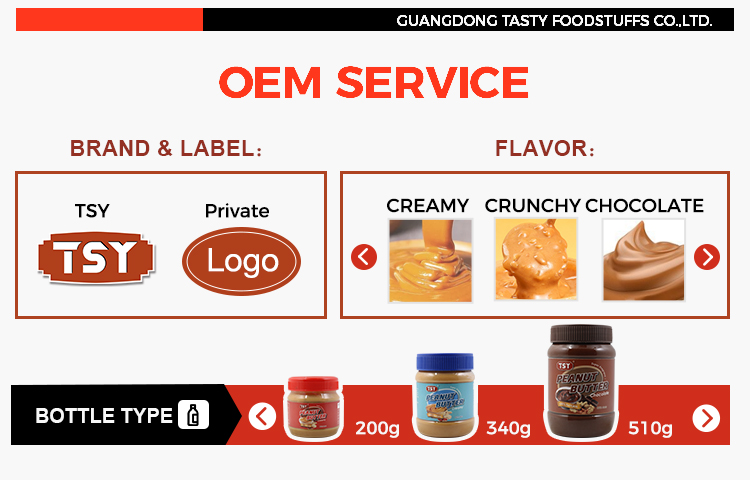
TSY or Custom Brands
| Availability: | |
|---|---|
| Quantity: | |
| Flavor | With the sweetness of chocolate and the aroma of peanuts |
| Ingredient | Peanuts, Glycerol Monostearate, Salt,Sugar |
| Serving Suggestion | It can be eaten straight or used as a dipping sauce for bread and toast, and as a fillings for ice cream or other desserts. |
| Nutrition information typical values per 100g | Energy 2655kJ/635Kcal Protein 22.1g Total fat 50.8g Carbohydrate 23.5g Sodium 560mg |
| Shelf Life | 24 months |
| STORAGE: | Keep at room temperature and moisture proof storage. Please closed After opening use,and store in dry cool place. |
| Certificate | HACCP, BRC, IFS, HALAL, KOSHER, ISO |
TSY food Peanut butter Core feature: Why is it so special?
Rich nutty aroma
The core charm lies in the deep and warm aroma of roasted nuts that emerges after roasting. This aroma originates from the Maillard reaction, stimulating one's appetite and possessing extremely strong recognition and comfort food attributes.
Rich and mellow taste
Smooth type: As fine as silk and with excellent spreadability.
Granular type: Fine crushed peanuts are embedded in a smooth base, providing a rich chewiness and a more authentic nutty experience.
High-quality peanut butter is thick and smooth when eaten, which can bring a strong sense of satisfaction.
The nutritional composition of gold
High-quality plant protein: It is an important source of protein supplementation for vegetarians and in their daily diet.
Healthy fats: Rich in monounsaturated and polyunsaturated fatty acids (mainly oleic acid), they are beneficial to heart health (consumed in moderation).
Dietary fiber and trace elements: Provide vitamin E, magnesium, potassium, phosphorus and antioxidant substances.
Energy-intensive: It is an ideal choice for athletes, outdoor enthusiasts and people who need to replenish energy quickly.
Pure ingredients, diverse choices:
Traditional/Conventional type: Usually contains peanuts, vegetable oil (to prevent the separation of oil and sauce), sugar, and salt, with a balanced flavor.
Natural type: The ingredient list is extremely simple, usually only "peanuts" or "peanuts + salt". Before consumption, the oil needs to be stirred and mixed, making the flavor more original.
Flavor type: It has derived flavors such as honey, chocolate, and spicy, catering to different preferences.
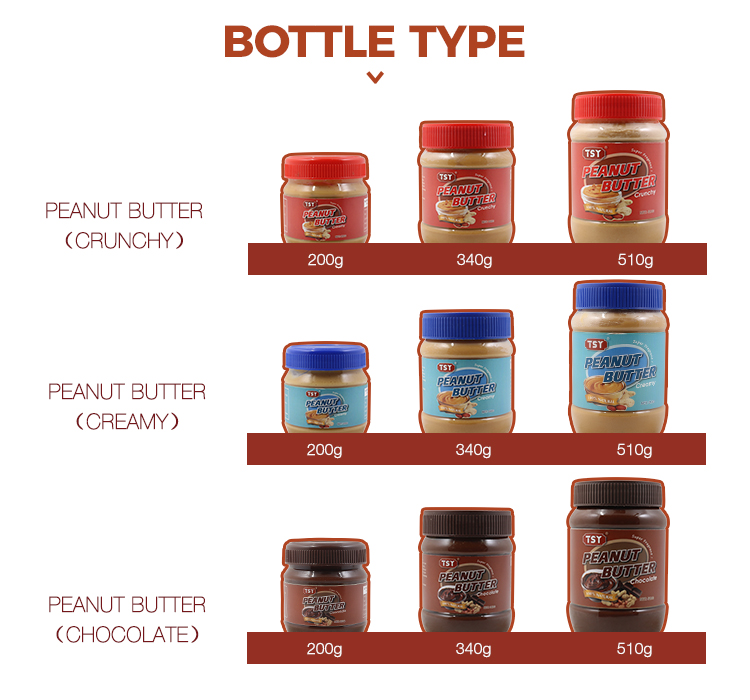
According to the different tastes and qualities requirements of different customers, we offer Creamy Peanut Butter, Crunchy Peanut Butter, Chocolate Peanut Butter for choice.


| SPECIFIATION PER CTN | PACKS TYPE | CARTON SIZE (CM) | G.WEIGHT (KGS) /CTN |
| 200g*24tins | Plastic Bottle | 28*21.3*16.5 | 5.80 |
| 340g*24tins | Plastic Bottle | 30.4*23.2*20.7 | 9.40 |
| 510g*24tins | Plastic Bottle | 32.8*24.8*25.7 | 14.20 |
| 1kg*12tins | Plastic Bottle | 38.8*29*17 | 13.00 |
* If you have other needs, please consult us.
Core uses of TSY food Peanut butter: Its infinite possibilities
Peanut butter has an extremely wide range of applications and is a "versatile player" in the kitchen.
1. Direct application and dipping (the most classic)
Breakfast partner: Spread on toast, bagels, steamed buns, waffles, pancakes.
Snack dipping sauce: It is a perfect combination for healthy snacks when dipping apple slices, bananas, celery sticks, carrot sticks and other fruits and vegetables.
Hot pot companion: In northern China, diluted peanut butter is the classic dipping base for mutton hot pot.
2. Beverages and Desserts (Flavor Magician)
Drinks: Add it to milk, yogurt, milkshakes, smoothies or oatmeal bowls to instantly enhance the flavor and nutritional concentration.
Baking: It is the core ingredient for making peanut butter cookies, brownies, cakes and pie fillings, bringing a rich nutty aroma.
Candies and ice cream: Used to make peanut candies, nougat, chocolate fillings, or as a flavor for ice cream.
3. Chinese Cooking and Seasoning (Application of Salty and Fresh Flavors)
Cold dishes: After dilution and mixing evenly, it is used for cold noodles, cold noodles, and cold dishes to add a rich base flavor (such as hot dry noodles, sesame paste cold noodles).
Hot pot and spicy hot pot: As the core of the sesame paste dipping sauce in the north, or the secret weapon to add a rich flavor to the flavors of Sichuan and Chongqing.
Compound sauce: It serves as the base for making satay sauce, some Southeast Asian dipping sauces, and various innovative fusion sauces.
4. Food industry raw materials
As an important ingredient for energy bars, protein bars, breakfast cereals, biscuit fillings, pre-prepared sauce packets, etc.
Iii. How to Choose and Store
Check the ingredients: In pursuit of pure flavor and health, a natural peanut butter with an optional ingredient list that only contains "peanuts" (or + salt) is available.
Observe the texture: It is a normal phenomenon for natural peanut butter to separate from the sauce after standing, and it can be restored after stirring. Uniform and non-stratified products may have added stabilizers.
Taste the texture: Choose smooth or granular according to your preference.
Storage: After opening the can, it must be sealed and stored in the refrigerator. This can delay the oxidation of the oil, maintain the flavor, and extend the shelf life (usually several months). Natural peanut butter will become hard when refrigerated. It can be restored to its original texture by taking it out and warming it up or stirring it.
1. Harvesting: Peanuts are harvested from fields when they are mature. The peanuts are usually pulled from the ground, dried, and then stored.
2. Shelling: After harvesting, the peanuts are shelled to remove the outer shell or hull. This can be done either manually or using machinery.
3. Roasting: The shelled peanuts are roasted to enhance flavor. Roasting can be done in large ovens, and it can vary in temperature and time depending on the desired flavor profile.
4. Cooling: After roasting, the peanuts are allowed to cool down. This step is essential before processing further.
5. Blanching: Some peanut butter varieties require blanching to remove the skins. This involves subjecting the peanuts to hot air, which causes the skins to loosen and be removed.
6. Grinding: The roasted (and optionally blanched) peanuts are ground into a paste. This is typically done using industrial grinders or mills. The grinding process can vary to achieve the desired texture, from smooth to chunky.
7. Additives: Depending on the brand and recipe, various additives such as salt, sugar, and stabilizers may be added to the peanut butter during the grinding process. These additives enhance flavor and extend shelf life.
8. Packaging: The final peanut butter paste is transferred into jars, cans, or other containers. These containers are sealed to ensure freshness and prevent spoilage.
9. Quality Control: Quality control checks are performed to ensure the product meets safety and quality standards. This includes testing for consistency, taste, and shelf life.
It's worth noting that the specific steps and methods can vary between different qualities or flavors, and some may use different variations of the process to create unique peanut butter products.