TSY or Custom Brands
| Availability: | |
|---|---|
| Quantity: | |
| Advantage | This type of soy sauce is specifically crafted to complement the various elements in sushi, such as fish, rice, and seaweed, providing a well-balanced and satisfying dipping experience. |
| Flavor | Umami Japanese sushi soy sauce for dipping combines the saltiness of regular soy sauce with a deep umami taste. |
| Ingredient | Water, Soy bean, Wheat Flour, Salt, Sugar, Yeast Extract, Caramel (E150C), Monosodium Glutamate (E621), Potassium Sorbate (E202), Sucralose (E955) |
| Serving Suggestion | Umami Japanese sushi soy sauce for dipping is especially suitable as a table condiment for sushi, sashimi, miso soup, udon, and other Japanese dishes. Harmonious, light, but long-lasting in taste. |
| Nutrition information typical values per 100g | Energy 160kJ/38Kcal Protein 7.1g Total fat 0g Carbohydrate 1.2g Sodium 7100mg |
| Shelf Life | 24 months |
| STORAGE: | Keep at room temperature and moisture proof storage. Please closed After opening use,and store in dry cool place. |
| Certificate | HACCP, BRC, IFS, HALAL, KOSHER, ISO |
| Advantage | This type of soy sauce is specifically crafted to complement the various elements in sushi, such as fish, rice, and seaweed, providing a well-balanced and satisfying dipping experience. |
| Flavor | Umami Japanese sushi soy sauce for dipping combines the saltiness of regular soy sauce with a deep umami taste. |
| Ingredient | Water, Soy bean, Wheat Flour, Salt, Sugar, Yeast Extract, Caramel (E150C), Monosodium Glutamate (E621), Potassium Sorbate (E202), Sucralose (E955) |
| Serving Suggestion | Umami Japanese sushi soy sauce for dipping is especially suitable as a table condiment for sushi, sashimi, miso soup, udon, and other Japanese dishes. Harmonious, light, but long-lasting in taste. |
| Nutrition information typical values per 100g | Energy 160kJ/38Kcal Protein 7.1g Total fat 0g Carbohydrate 1.2g Sodium 7100mg |
| Shelf Life | 24 months |
| STORAGE: | Keep at room temperature and moisture proof storage. Please closed After opening use,and store in dry cool place. |
| Certificate | HACCP, BRC, IFS, HALAL, KOSHER, ISO |
The nutrient content of Japanese sushi soy sauce produced in TSY can vary due to different product quality requirements, but here are some general nutritional components typically found in soy sauce:
1. Sodium: Soy sauce is often high in sodium, which contributes to its salty flavor. Excessive sodium intake should be moderated for those with specific health concerns.
2. Protein: While soy sauce contains some protein, it is not a significant source.
3. Calories: Soy sauce is relatively low in calories, as it's used in small quantities for flavoring.
4. Carbohydrates: It contains a small amount of carbohydrates, mainly from the wheat and soybean components.
5. Iron: Soy sauce can contain trace amounts of iron.
6. Naturally Occurring Amino Acids: Soy sauce is rich in naturally occurring amino acids, contributing to its umami flavor.
Overall, while soy sauce can add flavor to dishes, it is not a significant source of nutrients, and its high sodium content should be consumed in moderation. If you are looking for essential nutrients, it is best to focus on a well-balanced diet that includes a variety of whole foods.
The nutrient content of Japanese sushi soy sauce produced in TSY can vary due to different product quality requirements, but here are some general nutritional components typically found in soy sauce:
1. Sodium: Soy sauce is often high in sodium, which contributes to its salty flavor. Excessive sodium intake should be moderated for those with specific health concerns.
2. Protein: While soy sauce contains some protein, it is not a significant source.
3. Calories: Soy sauce is relatively low in calories, as it's used in small quantities for flavoring.
4. Carbohydrates: It contains a small amount of carbohydrates, mainly from the wheat and soybean components.
5. Iron: Soy sauce can contain trace amounts of iron.
6. Naturally Occurring Amino Acids: Soy sauce is rich in naturally occurring amino acids, contributing to its umami flavor.
Overall, while soy sauce can add flavor to dishes, it is not a significant source of nutrients, and its high sodium content should be consumed in moderation. If you are looking for essential nutrients, it is best to focus on a well-balanced diet that includes a variety of whole foods.
This specification of Japanese Sushi Soy Sauce for Dipping are suitable and cost-effective.

SPECIFIATION PER CTN | TYPE OF PACKAGING |
| 8ml*1000bags | Sachet |
| 10ml*250bags*4boxes | Sachet |
| 12ml*250bags*4boxes | Sachet |
| 25ml*150bags*4boxes | Sachet |
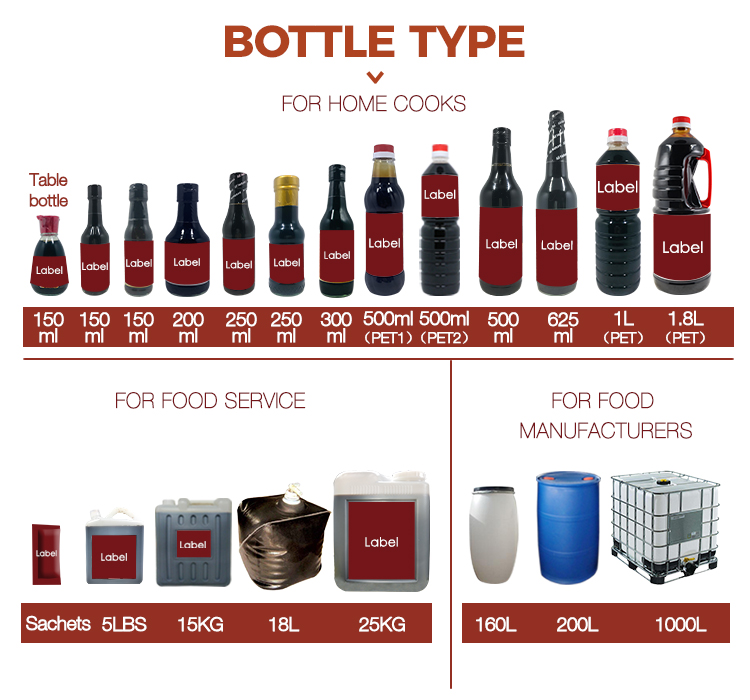
150ml*12btls/box*4boxes | Glass bottle |
150ml*24btls | Table bottle |
200ml*24btls | Glass bottle |
250ml*24btls | Glass bottle |
300ml*12btls | Glass bottle |
* If you have other needs, please consult us.
This specification of Japanese Sushi Soy Sauce for Dipping are suitable and cost-effective.

SPECIFIATION PER CTN | TYPE OF PACKAGING |
| 8ml*1000bags | Sachet |
| 10ml*250bags*4boxes | Sachet |
| 12ml*250bags*4boxes | Sachet |
| 25ml*150bags*4boxes | Sachet |
150ml*12btls/box*4boxes | Glass bottle |
150ml*24btls | Table bottle |
200ml*24btls | Glass bottle |
250ml*24btls | Glass bottle |
300ml*12btls | Glass bottle |
* If you have other needs, please consult us.
Summary of the universal cooking functions of TSY Japanese Soy sauce
Regardless of the type, Japanese soy sauce all have the following core functions:
Enhancing freshness: The amino acids it is rich in are a natural source of umami, which can awaken the original flavor of the ingredients.
Flavor enhancement: The complex fermentation process produces a unique sauce aroma, which becomes even more intense after heating.
Coloring: Especially thick and smooth soy sauce can endow dishes with an alluring bright red color.
Eliminating fishy smell and greasiness: It can effectively remove fishy odors when marinating or cooking meat and seafood.
Establishing the base flavor: It is the taste foundation of Japanese dashi and sauces.
Tips for using TSY Japanese soy sauce:
For dipping: High-quality sashimi soy sauce or dipping sauce is best eaten directly as a dip rather than mixed with mustard to avoid spoiling the flavor.
Heating timing: Dishes that need to be colored (such as teriyaki) can be added earlier. Dishes that only need to enhance their freshness can be added later to retain their aroma.
Alternative to Chinese soy sauce: In daily Chinese cuisine, thick soy sauce can be used to replace light soy sauce, and a small amount of dark soy sauce can be used to replace dark soy sauce (but the color and sweetness are different and need to be adjusted).
In conclusion, TSY Japanese soy sauce is a sophisticated art. Choosing the right type can elevate the flavor of your dishes to a new level.
Summary of the universal cooking functions of TSY Japanese Soy sauce
Regardless of the type, Japanese soy sauce all have the following core functions:
Enhancing freshness: The amino acids it is rich in are a natural source of umami, which can awaken the original flavor of the ingredients.
Flavor enhancement: The complex fermentation process produces a unique sauce aroma, which becomes even more intense after heating.
Coloring: Especially thick and smooth soy sauce can endow dishes with an alluring bright red color.
Eliminating fishy smell and greasiness: It can effectively remove fishy odors when marinating or cooking meat and seafood.
Establishing the base flavor: It is the taste foundation of Japanese dashi and sauces.
Tips for using TSY Japanese soy sauce:
For dipping: High-quality sashimi soy sauce or dipping sauce is best eaten directly as a dip rather than mixed with mustard to avoid spoiling the flavor.
Heating timing: Dishes that need to be colored (such as teriyaki) can be added earlier. Dishes that only need to enhance their freshness can be added later to retain their aroma.
Alternative to Chinese soy sauce: In daily Chinese cuisine, thick soy sauce can be used to replace light soy sauce, and a small amount of dark soy sauce can be used to replace dark soy sauce (but the color and sweetness are different and need to be adjusted).
In conclusion, TSY Japanese soy sauce is a sophisticated art. Choosing the right type can elevate the flavor of your dishes to a new level.
Q: Is TSY soy sauce purely naturally brewed? Are there any additives?
A: Yes, all TSY core series soy sauces are brewed using traditional ancient methods. They are made from only water, non-GMO defatted soybeans, wheat, table salt (iodine-free), and white granulated sugar, and are fermented for a full period. Our "Zero Additive" series of products guarantee that no preservatives, monosodium glutamate, colorants or sweeteners are added. For other series, if specific flavors are to be met, compliant flavor enhancers will be added. All of them comply with international safety standards and will be clearly labeled in the ingredient list. Please feel free to purchase.
Q: What is the most fundamental difference between light soy sauce and dark soy sauce?
A: The simplest way to distinguish
Light soy sauce: It is mainly used for seasoning and enhancing freshness. It has a light color and a strong salty taste, and is used for stir-frying, cold dishes, and dipping.
Dark soy sauce: It mainly serves to enhance color, has a deep hue, and a caramel sweetness. It is used in braising, marinating, and stewing.
Q: How to store soy sauce? Does it need to be refrigerated after opening?
A: It is recommended to store soy sauce in a cool and dark place. After opening, to ensure the best flavor and quality, we strongly recommend refrigerating. Refrigeration can slow down the oxidation and fermentation process of soy sauce, prevent flavor loss and the growth of microorganisms at the bottle mouth.
Q: Sometimes white crystals or sediment appear at the mouth of the soy sauce bottle. Does it mean it has gone bad?
A: Please rest assured that this is usually amino acid salt crystallization, a natural phenomenon where the abundant amino acids in soy sauce precipitate at low temperatures or high concentrations. It is one of the signs of pure grain brewing and is harmless to the human body, allowing for normal consumption. Shake well until well combined.
Q: How long is the shelf life of TSY soy sauce?
A: The shelf life of unopened TSY soy sauce is generally 24 months. For the exact date, please refer to the product bottle. After opening, it is recommended to use it up within 3 months to achieve the best flavor.
Q: Is TSY soy sauce purely naturally brewed? Are there any additives?
A: Yes, all TSY core series soy sauces are brewed using traditional ancient methods. They are made from only water, non-GMO defatted soybeans, wheat, table salt (iodine-free), and white granulated sugar, and are fermented for a full period. Our "Zero Additive" series of products guarantee that no preservatives, monosodium glutamate, colorants or sweeteners are added. For other series, if specific flavors are to be met, compliant flavor enhancers will be added. All of them comply with international safety standards and will be clearly labeled in the ingredient list. Please feel free to purchase.
Q: What is the most fundamental difference between light soy sauce and dark soy sauce?
A: The simplest way to distinguish
Light soy sauce: It is mainly used for seasoning and enhancing freshness. It has a light color and a strong salty taste, and is used for stir-frying, cold dishes, and dipping.
Dark soy sauce: It mainly serves to enhance color, has a deep hue, and a caramel sweetness. It is used in braising, marinating, and stewing.
Q: How to store soy sauce? Does it need to be refrigerated after opening?
A: It is recommended to store soy sauce in a cool and dark place. After opening, to ensure the best flavor and quality, we strongly recommend refrigerating. Refrigeration can slow down the oxidation and fermentation process of soy sauce, prevent flavor loss and the growth of microorganisms at the bottle mouth.
Q: Sometimes white crystals or sediment appear at the mouth of the soy sauce bottle. Does it mean it has gone bad?
A: Please rest assured that this is usually amino acid salt crystallization, a natural phenomenon where the abundant amino acids in soy sauce precipitate at low temperatures or high concentrations. It is one of the signs of pure grain brewing and is harmless to the human body, allowing for normal consumption. Shake well until well combined.
Q: How long is the shelf life of TSY soy sauce?
A: The shelf life of unopened TSY soy sauce is generally 24 months. For the exact date, please refer to the product bottle. After opening, it is recommended to use it up within 3 months to achieve the best flavor.