Is Oyster Sauce Considered MSG?
Walk into any Asian grocery store's sauce aisle, and you'll see shelves lined with various brands of oyster sauce. Pick up a bottle, flip it over, and you'll often find a word on the ingredients list that makes many people wary: monosodium glutamate (MSG)—what we commonly know as "flavor enhancer." This naturally raises a question: Is oyster sauce itself a form of "natural MSG"? And what exactly is its relationship with MSG?
This question seems simple, but it touches on the intersection of food science, culinary tradition, and public health anxiety. This article will thoroughly clarify these two concepts, giving you not only the answer but also the scientific principles behind it.
Part One: The Core Answer – Oyster Sauce Is Not MSG, But They Are "Relatives"
The direct answer is: Oyster sauce is not MSG, but oyster sauce naturally contains the same core component as MSG—glutamate.
To understand this relationship, let's use an analogy:
MSG is to oyster sauce what alcohol is to wine. Wine naturally contains alcohol, but you wouldn't say "wine is alcohol." Similarly, oyster sauce naturally contains glutamate (the active component of MSG), but oyster sauce is far more than just MSG.
MSG is a single compound with over 99% purity—sodium glutamate. Oyster sauce, on the other hand, is a complex condiment made by simmering and reducing oysters. It contains proteins, peptides, sugars, minerals, and various amino acids, including glutamate.
Remember it this way: MSG is a single ingredient; oyster sauce is a complex blend of many ingredients.
Part Two: The Science – Why Is Oyster Sauce "Umami"?
To understand the relationship between oyster sauce and MSG, we first need to understand the scientific nature of "umami."
The Discovery of Umami
In 1908, Japanese chemist Dr. Kikunae Ikeda isolated the source of umami from a bowl of kombu (kelp) broth—glutamic acid. He discovered that this amino acid produces a unique taste distinct from sweet, sour, bitter, and salty, which he named "Umami." Subsequently, he developed a method to stabilize glutamic acid into crystals, and monosodium glutamate (MSG) was born.
The key point: Glutamic acid occurs naturally in many foods, including tomatoes, mushrooms, seaweed, cheese, meat—and oysters.
Glutamate Content in Oyster Sauce
Scientific research confirms that oyster sauce is rich in glutamate. According to the Umami Information Center, the naturally occurring glutamate content in oyster sauce is approximately 900 mg per 100 grams.
A recent study published in 2025 provided even more precise data: Researchers used liquid chromatography-tandem mass spectrometry (LC-MS/MS) to analyze oyster sauce and identified 18 amino acids, among which glutamic acid had the highest concentration, reaching 1.72 × 10⁶ ng/g—that is, approximately 1.72 mg of glutamate per gram of oyster sauce.
These numbers tell us a fact: the umami in oyster sauce isn't "added"—it comes naturally from the oysters themselves.
Part Three: Production Processes Compared – How Is a Bottle of Oyster Sauce Made?
After understanding the science, let's look at the production processes. This will help you intuitively grasp the difference between the two.
Traditional Oyster Sauce Production: An Art of Time
Traditional oyster sauce production is more like a craft:
Fresh oysters are shucked and placed in a pot, then simmered slowly in water
As water evaporates, the proteins in the oysters gradually hydrolyze, releasing free amino acids (including umami-contributing substances like glutamic acid and aspartic acid)
The oyster meat is filtered out, and the liquid continues to simmer
When the liquid becomes thick and turns a deep brown color, concentrated oyster sauce is obtained
This process is similar to making a rich stock—it's physical extraction, not chemical synthesis. Traditional production uses no thickeners or additives, relying entirely on the oysters' own components.
Modern Commercial Production: Balancing Efficiency and Cost
Today's commercially available oyster sauces are often produced differently. Because pure oyster extract is extremely expensive, commercial products typically:
Use a relatively low proportion of oyster extract (some as low as 4-10%)
Add sugar, salt, modified starch (for thickening), and caramel color (for coloring)
May add MSG to enhance umami
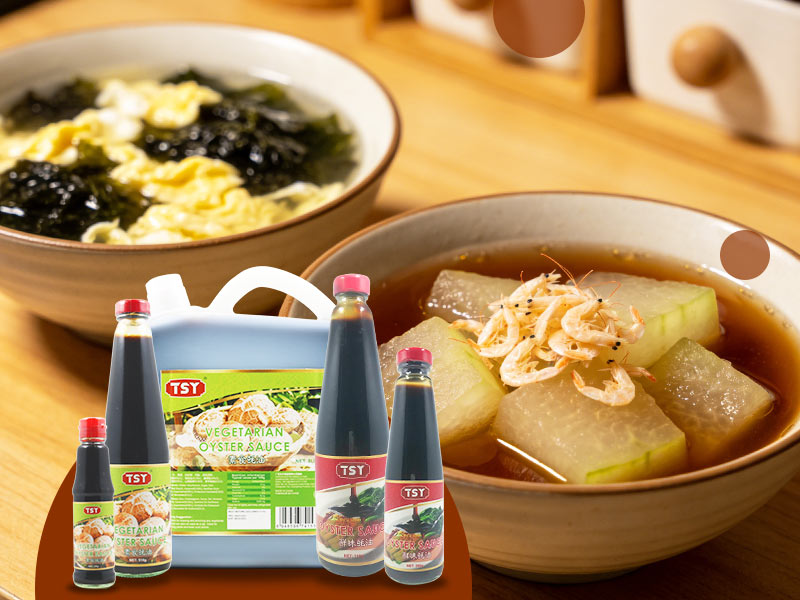
For example, the ingredient list for TSY brand oyster sauce reads: Water, Sugar, Oyster Extract (9%), Modified Tapioca Starch, Salt, Wheat Flour, Lactic Acid, Plain Caramel. Another product's testing showed oyster extract content of only 4%, along with 1% added MSG.
This explains why some oyster sauces list "monosodium glutamate" or "flavor enhancer" on their labels—not because oyster sauce itself is MSG, but because manufacturers have added extra MSG to the sauce.
MSG Production: Microbial Fermentation
In contrast, modern MSG production uses a fermentation process similar to yogurt or beer production:
Raw materials such as molasses or corn starch are used
Microorganisms such as Corynebacterium glutamicum ferment the sugars
The microorganisms convert the sugar into glutamic acid
After extraction, purification, and crystallization, a high-purity white crystalline powder—MSG—is obtained
MSG typically has a purity of over 99%, with a single, well-defined composition.
Part Four: A Clear Comparison at a Glance
| Feature | MSG (Monosodium Glutamate) | Oyster Sauce |
| Nature | Single chemical pure substance | Complex condiment |
| Composition | 99%+ sodium glutamate | Water, oyster extract, sugar, salt, starch, various amino acids, etc. |
| Source | Microbial fermentation followed by chemical extraction | Simmering and concentration of oysters |
| Umami substance | Itself is the umami substance | Naturally contains glutamate and other umami substances |
| Flavor | Single umami note | Complex flavor (umami, salty, sweet, oyster aroma) |
| Form | White crystalline granules | Thick, dark brown sauce |
Part Five: Why Do People Confuse the Two?
The confusion arises from several reasons:
1. The Same Source of Umami
Both oyster sauce and MSG provide umami, and the chemical nature of that umami is identical—both stimulate the umami receptors on your tongue through glutamic acid. When you add oyster sauce to a dish, the "umami" you experience is physiologically the same sensation as when you add MSG.
2. Many Commercial Oyster Sauces Have Added MSG
This is the most direct reason. To achieve the desired level of umami without using expensive oyster extract, many mid-to-low-end brands explicitly add MSG as a flavor enhancer. This gives consumers the impression: "Oyster sauce tastes like MSG, so oyster sauce must be made from MSG."
3. Misunderstood Historical Context
As a Chinese health website once noted, "Oyster sauce is extracted from oysters—this is a natural seasoning that has similarities to the MSG we discussed earlier." The "similarities" refer to both providing umami through glutamate, not to them being the same thing. But such phrasing can easily be misinterpreted.
Part Six: Current Market – More "No Added MSG" Oyster Sauces Are Appearing
Notably, in recent years, driven by consumer demand for "clean labels," "No Added MSG" oyster sauce products have become increasingly common.
For example, TSY's brand oyster sauce clearly states "No Added MSG"; Thai TSY brand oyster sauce similarly states "No Added MSG." The umami in these products comes entirely from the oyster extract itself and the naturally occurring glutamate in the ingredients.
This means: If you're concerned about MSG, you can absolutely choose "No Added MSG" oyster sauce products—these products are sufficiently flavorful on their own.
Part Seven: Frequently Asked Questions
Q1: Does eating oyster sauce equal eating MSG?
No. Unless you're choosing a low-end oyster sauce that has a large amount of added MSG, the main component you're ingesting is naturally occurring glutamate from oysters. That said, even natural glutamate is chemically identical at the molecular level to the glutamate in added MSG—your body cannot distinguish between "natural" and "added" glutamate. The difference lies in the quantity consumed and the accompanying substances.
Q2: Is MSG safe?
Major global food safety authorities (including the WHO, FDA, and EFSA) have all determined that MSG is safe for consumption within normal intake ranges. The so-called "Chinese Restaurant Syndrome" has not been substantiated by rigorous scientific studies. A small number of individuals may be sensitive to large amounts of MSG, experiencing temporary symptoms like headaches or dry mouth—but this is an individual sensitivity, not evidence of toxicity.
Q3: Which is better—naturally occurring glutamate in oyster sauce or added MSG?
From a nutritional perspective, the body metabolizes both in the same way. However, naturally occurring glutamate in oyster sauce comes packaged with other nutrients (such as other amino acids and minerals), while pure MSG contains only sodium glutamate. From a "whole food" perspective, oyster sauce is closer to a natural food product.
Q4: How should I choose an oyster sauce?
| Need | Recommendation |
| Seeking natural product | Choose products where oyster extract is listed early in the ingredients and "monosodium glutamate" does not appear |
| Sodium control | Compare the sodium content on the nutrition facts panel and choose the lower option |
| Value for money | Mid-tier brands are sufficient; you don't need the most expensive |
| No added MSG | Choose products explicitly labeled "No Added MSG" |
Part Eight: Conclusion – Clarification Empowers Better Choices
Returning to the original question: Is oyster sauce considered MSG?
The scientific answer is no. Oyster sauce is a complex condiment made from oysters through a simmering process. It naturally contains various amino acids (the most abundant of which is glutamic acid). MSG, on the other hand, is a purified single compound—sodium glutamate. Both provide umami, but the flavor profile of oyster sauce is far richer than that of plain MSG.
What's the value of understanding this difference? It helps us move beyond an "all-or-nothing" mindset:
If you have no objection to MSG (scientific consensus considers it safe), then you can happily accept oyster sauces with added MSG—they simply achieve a more intense umami at a lower cost.
If you prefer "natural" or "clean label" products, you can choose high-quality oyster sauces without added MSG, whose umami comes entirely from the oysters themselves.
Regardless of your choice, oyster sauce is a tool for enhancing flavor in cooking. The key is using it in moderation—after all, its sodium and sugar content are far more relevant health considerations.
Oyster sauce is not MSG, but its soul—umami—comes from the same chemical family as MSG. This answer both clarifies the facts and respects the respective rationalities of culinary tradition and modern food science. The next time you're stir-frying, you can reach for that bottle of oyster sauce with confidence, knowing what you're using and why you're using it.