The Magic in the Kitchen: The Past and Present of Mayonnaise and Salad Dressing
Keywords: Emulsification Technology, Mayonnaise, Vinaigrette, Food Science
Introduction
In the fast-paced rhythm of modern life, whether it's a quick sandwich during a busy morning, a hint of green in a light meal during weight loss, or a plate of delicious salad for a weekend gathering, one essential component is indispensable—the sauce.
As a factory specializing in the production of mayonnaise and salad dressing for many years, we work daily with oil, water, eggs, and vinegar. We witness firsthand how these simple ingredients transform, through magical physical and chemical processes, into smooth-textured, flavorful condiments. Today, standing from a producer's perspective, we aim to unveil the mysteries of mayonnaise and salad dressing, taking you behind the scenes of these everyday delights and explaining the scientific principles that make them possible.
Part 1: Defining Identity – Are Mayonnaise and Salad Dressing Really the Same Thing?
This is the most common point of confusion for consumers, and it's also the most fundamental concept in our production process.
Salad Dressing is actually a broad, general term. Simply put, any sauce used to accompany a salad, making the ingredients more flavorful and the texture smoother, can be called a salad dressing. It mainly consists of two major camps:
Creamy Style: Thick in texture, centered around emulsification technology.
Vinaigrette Type: Thin in texture, flowing like water, mainly consisting of oil and vinegar mixed together by shaking .
Mayonnaise, on the other hand, is the "originator" and "patriarch" of the creamy-style dressings. The mayonnaise produced in our factory specifically refers to a semi-solid, oil-in-water (O/W) emulsion, primarily made from vegetable oil, egg yolk, and vinegar (or lemon juice) , leveraging the powerful emulsifying properties of the egg yolk .
Think of it this way: All mayonnaise is salad dressing, but not all salad dressings can be called mayonnaise. Variants like Thousand Island dressing, Caesar dressing, and Ranch dressing are all "mutations" derived from a mayonnaise base, enhanced with different flavorful ingredients (such as ketchup, pickles, cheese, bacon bits, etc.) .
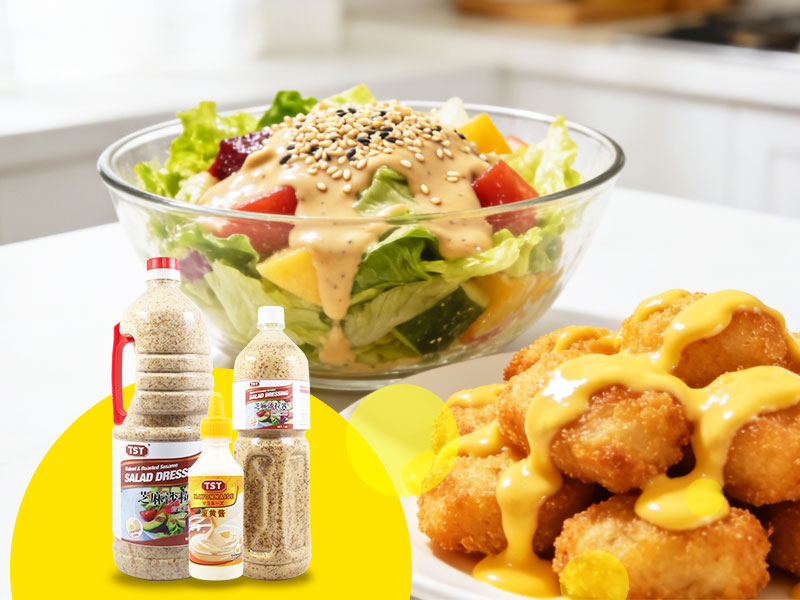
Part 2: Echoes of History – The Mediterranean Legend of Mayonnaise
As producers, every time we start the emulsifier, we can't help but think of this classic tale of culinary dissemination.
Mayonnaise wasn't born in a modern factory but originated over 200 years ago in the Mediterranean. In 1756, French troops captured the island of Minorca in the western Mediterranean during the war. In the port of Mahón, French officers encountered a local, primitive sauce made from olive oil and egg yolk, which the locals called "Mahonesa." This unique flavor amazed the officers accustomed to grand French cuisine, who then brought the recipe for this sauce back to Paris .
Interestingly, before the French, the British had occupied the island for nearly 50 years but had overlooked this local delicacy. It was the French, passionate about gastronomy, who embraced and popularized it, naming it "Mayonnaise" in French, from where it spread worldwide .
This history tells us that the spread of food requires curiosity and creativity. Today, as a factory, we are the inheritors of this creativity. Through industrial methods, we bring this accidental delicacy from a small island safely and consistently to tables everywhere.
Part 3: Factory Secrets – How to "Create" Thickness from Nothing?
Why is it that at home, oil remains oil and vinegar remains vinegar, never mixing, while in a factory they can transform into a stable, thick, non-separating sauce? The core process behind this is called emulsification technology.
This is a classic "oil-in-water" system. Inside our production workshop, a wondrous "micro-magic" show takes place:
Ingredient Selection (The Supporting Cast Debuts): We use high-quality edible oils (like soybean oil, canola oil) as the "internal phase," making up 50%-80% of the total. Purified water, fresh eggs, and brewed vinegar form the "external phase" .
The Role of Egg Yolk (The Key Player): Egg yolk is rich in lecithin, a natural and highly effective emulsifier. Its molecular structure is unique: one end is "hydrophilic" (water-loving), and the other is "lipophilic" (oil-loving) .
High-Speed Dispersion & Homogenization (The Magic Moment): Inside a vacuum emulsifier, as the rotor spins at extremely high speeds, the oil is broken down into countless tiny oil droplets, dispersed within the water and vinegar mixture. Immediately, the lecithin from the egg yolk adsorbs onto the surface of each tiny oil droplet. The lipophilic end inserts itself into the oil droplet, while the hydrophilic end extends outward into the surrounding water phase .
Stabilization & Formation: Consequently, each tiny oil droplet is encased in a protective film. Due to electrical charge and steric hindrance, these droplets cannot recombine. The dense packing of countless encapsulated micro-droplets results in the viscous, flowable semi-solid we recognize as mayonnaise .
It is through this precise physical and chemical process that we achieve the miracle of "oil and water mixing."
Part 4: Expansion of the Family – From Mayonnaise to Versatile Salad Dressings
From our production line perspective, mayonnaise is just the "bare shell." To offer consumers a richer taste journey, we expand into a vast family of salad dressings through subsequent blending processes:
Thousand Island Dressing: Named after the Thousand Islands region on the border between the U.S. and Canada. It starts with a mayonnaise base and adds ketchup, chopped pickles, onions, and green peppers. It has a tangy, sweet, and appetizing flavor with a pleasant texture, making it excellent for seafood salads or as a dip for fried foods .
Caesar Dressing: Originating from the Caesar's Restaurant in Mexico. It incorporates grated Parmesan cheese, garlic, black pepper, Worcestershire sauce, and even anchovies into a mayonnaise base. It offers a savory, rich flavor with cheesy and complex spice notes, and is the soulmate of the Caesar salad .
Ranch Dressing: The most popular salad dressing in the U.S. Based on mayonnaise, it's blended with yogurt (or buttermilk), garlic powder, onion powder, and fresh herbs like dill and parsley. It has a fresh, creamy flavor, perfect not only for salads but also as a dip for veggie sticks and chicken wings .
Honey Mustard Dressing: A mix of mayonnaise with honey and mustard. The sweet and spicy combination creates a mild, palatable flavor, ideal for fried chicken and burgers .
Additionally, there's the Vinaigrette, created to cater to health-conscious trends. It doesn't use egg yolk for emulsification; instead, it relies on the natural separation of oil and vinegar, requiring a shake before use. This represents a minimalist aesthetic and is relatively lower in calories .
Part 5: Factory Commitment – The Balance Between Flavor and Safety
In an era where consumers are increasingly health-conscious, we face numerous challenges. Many worry that salad dressings are high in calories, labeling them as "calorie bombs." Indeed, because the base ingredient of mayonnaise has a high proportion of oil, its caloric value is undeniably significant. One tablespoon (about 15 grams) of mayonnaise can contain nearly 100 calories and a considerable amount of fat .
As a responsible manufacturer, we continuously pursue technological innovation:
Fat Reduction & Clean Label: We have developed low-fat and reduced-fat lines. By using modified starch or hydrocolloids to partially replace the texture of oil while maintaining system stability . We also strive to simplify ingredient lists, using more natural preservatives (like lemon juice, Vitamin E) or extending shelf life through stringent production hygiene controls (e.g., enclosed equipment disinfection, pasteurization) to meet consumer demand for "clean labels" .
Stringent Hygiene Standards: Inside the factory, production equipment is highly sealed, air is purified, and all contact surfaces undergo rigorous CIP (Clean-in-Place) cleaning. Since mayonnaise is considered a "raw" food (typically not heat-sterilized to avoid damaging the emulsion), the requirements for raw material microbial control and the cleanliness of the production environment are extremely high .
Pursuit of Stability: By controlling the pH (typically around 3.0-4.0), adding salt, and precise homogenization processes, we ensure the product remains non-separating, non-discoloring, and non-spoiling throughout its months-long shelf life. Whether you're in the cold north or the hot south, the quality remains consistent when you open the bottle .
Conclusion
From a single egg yolk to a drop of clear vinegar, through the high-speed rotor in our factory, and finally into that dollop of fragrant creaminess before you. Mayonnaise and salad dressing are no longer just condiments; they are partners in life, blending history, science, and art.
The next time you dip a french fry into Thousand Island dressing or prepare a creamy tuna salad for your kids, I hope you'll remember that behind it all, there's a factory diligently guarding this white magic from the Mediterranean with scientific rigor and romantic culinary passion. We are committed to remaining that behind-the-scenes "magician," carefully crafting every jar of sauce to add more flavor and joy to your dining table.
If you are interested in wholesale of sauces and noodles, you can leave a comment below, send us a message through our website, or connect with us on social media. Please feel free to contact us TSY Food for a good price.