Mayonnaise and Sesame Salad Dressing: A Comprehensive Comparison from Ingredients, Processes, to Applications
Introduction
On the shelves of modern kitchens, mayonnaise and sesame salad dressing are both common “white” sauces. They share a similar milky-white or pale-yellow appearance, often come in bottles or pouches, and are frequently placed side by side on supermarket shelves. This visual similarity leads many to wonder: are they the same thing? Or, is sesame salad dressing merely a “variant” of mayonnaise?
In fact, while there is an intersection—the base of sesame salad dressing is often mayonnaise—there are fundamental differences between the two in terms of ingredients, production processes, flavor profiles, cultural backgrounds, and culinary applications. Understanding these differences not only helps us choose condiments more accurately but also allows for greater flexibility in cooking.
This article will provide a comprehensive comparison of mayonnaise and sesame salad dressing from six dimensions: historical origins, ingredient analysis, production processes, sensory characteristics, nutritional value, and culinary applications.
Chapter 1: Historical Origins – The Evolution of Two Sauces
1.1 The Origin of Mayonnaise: From a Mediterranean Accident to a Global Condiment
There are several legends surrounding the birth of mayonnaise. The most widely circulated one dates back to a European war in the mid-18th century. In 1756, the French Duke de Richelieu captured Mahón, the capital of Menorca, Spain. During the celebratory feast, his chef, lacking the cream sauce typically used, improvised by emulsifying olive oil with egg yolks, accidentally creating this new sauce. To commemorate the victory, it was named “Salsa Mahonesa,” which later evolved into the French “Mayonnaise.”
Of course, this is just one of many accounts. Some food historians point to ancient Mediterranean recipes that already featured similar emulsions of egg yolk and olive oil. Regardless, mayonnaise spread across Europe in the 19th century alongside French haute cuisine and entered industrial production during the Industrial Revolution. By the early 20th century, thanks to advances in refrigeration and promotion by multinational food companies, mayonnaise had become a staple in households worldwide.
1.2 The Evolution of Sesame Salad Dressing: A Product of East-West Fusion
The history of sesame salad dressing is more complex. Its core ingredient—sesame paste—has a long history in Asian cuisine. China, Japan, Korea, and other East Asian nations have cultivated and consumed sesame for thousands of years, with sesame paste holding a significant place in traditional cooking.
However, the sesame salad dressing we know today is a product of East-West culinary fusion. In the mid-20th century, as mayonnaise became popular in Asian countries like Japan, local food manufacturers began experimenting. They combined traditional sesame paste with Western-style mayonnaise, adding native seasonings like soy sauce, mirin, sugar, and vinegar to create a new, complex condiment that retained the aroma of sesame while possessing the smooth texture of Western-style dressings.
This sauce was initially used primarily in Japanese cuisine, particularly for Japanese-style salads and as a dipping sauce for shabu-shabu. As Japanese cuisine gained global popularity, sesame salad dressing entered international markets and became a representative of Asian-style salad dressings.
Chapter 2: Ingredient Analysis – Composition Defines Essence
2.1 Ingredient Composition of Mayonnaise
The ingredient list for standard mayonnaise is relatively simple, typically including:
1. Vegetable Oil: The primary component, accounting for 65%-80% of the total. Commonly used oils include soybean oil, canola oil, and corn oil, which have neutral flavors. High-quality mayonnaise may use olive oil or avocado oil.
2. Egg Yolk: Provides emulsification, accounting for about 5%-10%. The lecithin in egg yolk acts as a natural emulsifier, allowing oil and water (vinegar) to mix stably.
3. Acidic Liquid: Typically vinegar (white, distilled, or apple cider) or lemon juice, accounting for about 5%-10%. The acid not only adds flavor but also helps stabilize the emulsion and acts as a preservative.
4. Seasonings: Salt, sugar, and mustard (especially Dijon mustard). Mustard adds flavor and its mucilaginous components aid emulsification.
5. Water: Some commercial mayonnaises add a small amount of water to adjust texture.
Key Characteristics of Mayonnaise: Contains no sesame ingredients, nor any Asian seasonings like soy sauce or mirin. Its flavor profile is based on sourness, saltiness, and the taste of the oil. It is a foundational condiment.
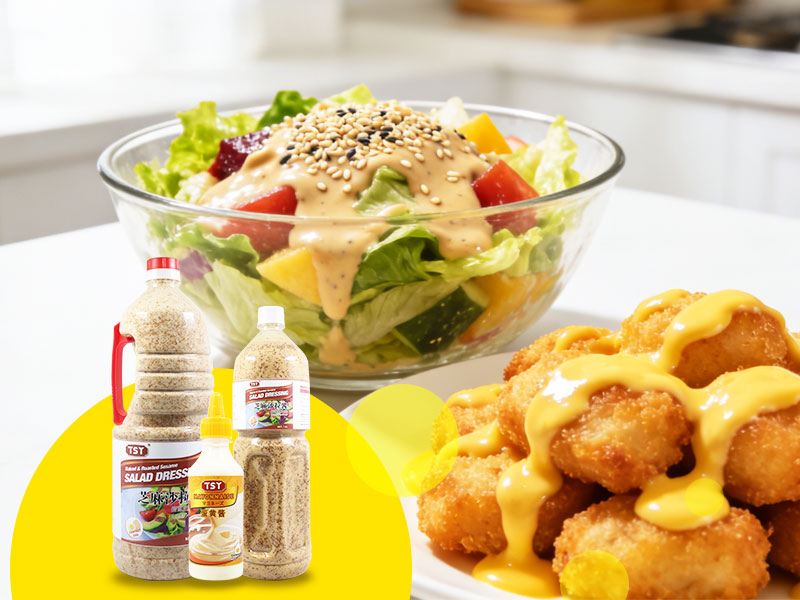
2.2 Ingredient Composition of Sesame Salad Dressing
The ingredient list for sesame salad dressing is significantly more complex and can be broken down into several categories:
1. Base Component: The vast majority of commercial sesame dressings use mayonnaise or a mayonnaise-like emulsion as their base. This means their primary components are still vegetable oil, egg yolk, and vinegar, but the proportions may differ from pure mayonnaise.
2. Sesame Component: This is the key differentiator. It typically consists of sesame paste (made from ground roasted white sesame) or roasted ground sesame seeds. This component gives the dressing its rich nutty aroma and characteristic sesame flavor. Some products use black sesame paste for added color and flavor complexity.
3. Asian Seasonings:
Soy Sauce: Provides saltiness and umami.
Mirin: A sweet rice wine that adds sweetness and gloss.
Sugar: Further increases sweetness.
Rice Vinegar or Grain Vinegar: Provides acidity, usually milder than that of mayonnaise.
Sake: Used in some recipes.
4. Flavor Enhancers: Many sesame dressings also incorporate ingredients like onion purée, garlic purée, and ginger to add complexity. Some use monosodium glutamate (MSG) or yeast extract to enhance umami.
5. Thickeners and Stabilizers: Due to the complex ingredient mix, commercial sesame dressings often include food additives like xanthan gum or modified starch to maintain texture stability.
Key Characteristics of Sesame Salad Dressing: Uses mayonnaise as a base but adds sesame paste and various Asian seasonings, resulting in a much more complex flavor profile than pure mayonnaise.
2.3 Summary of Key Ingredient Differences
| Ingredient Category | Mayonnaise | Sesame Salad Dressing |
| Vegetable Oil | 65%-80% | 30%-50% (as part of the base) |
| Egg Yolk | Present | Present (from the base) |
| Acidic Liquid | Present (vinegar/lemon juice) | Present (typically rice vinegar) |
| Sesame Component | None | Present (sesame paste or roasted sesame) |
| Soy Sauce/Mirin | None | Present |
| Sugar | Small amount | Higher amount |
| Flavor Enhancers | Mustard, salt | Onion, garlic, ginger, etc. |
Chapter 3: Production Processes – Differences in Emulsion Systems
3.1 The Emulsification Process of Mayonnaise
Mayonnaise is essentially an oil-in-water emulsion, or more precisely, a system where oil droplets are dispersed in a continuous water phase. The core challenge in making mayonnaise is achieving stable mixing between oil and water, two immiscible liquids.
The traditional hand-made process involves combining the water-phase ingredients (egg yolk, vinegar, salt, mustard) and whisking them together. Then, vegetable oil is added very slowly, drop by drop, while whisking continuously and vigorously. With each drop of oil, the lecithin in the egg yolk coats the oil droplet, allowing it to disperse into the water phase and forming a stable emulsion. As more oil is added, the emulsion thickens, eventually becoming a semi-solid paste.
Industrial production uses high-speed emulsification equipment but follows the same principle. Key control parameters include:
Oil-to-Water Ratio: Too much oil can cause the emulsion to break, while too little results in a thin consistency.
Emulsification Temperature: Typically controlled between 20-25°C (68-77°F).
Mixing Speed and Time: Requires sufficient shear force to create small, stable oil droplets.
3.2 The Complex Process of Sesame Salad Dressing
Producing sesame salad dressing is more complex as it involves integrating multiple component systems.
First, sesame paste itself is a system dominated by the oil phase (roasted sesame releases its natural oils as it is ground). To uniformly mix sesame paste with the mayonnaise base, the different rheological properties of each must be overcome.
A typical industrial production process looks like this:
Prepare Mayonnaise Base: Create the foundational emulsion according to standard mayonnaise methods.
Prepare Sesame Paste Slurry: Premix the sesame paste with liquid seasonings like soy sauce, mirin, sugar, and vinegar to form a uniform paste.
Secondary Emulsification: Slowly add the sesame paste slurry to the mayonnaise base, mixing to create a secondary emulsion.
Add Flavor Enhancers: Incorporate ingredients like onion and garlic purées, mixing thoroughly.
Homogenization: Use a high-pressure homogenizer to refine particles and ensure a smooth texture.
Pasteurization and Filling: Typically pasteurized and then cold-filled.
Compared to mayonnaise, the emulsion of sesame dressing is more delicate. The natural oils and solid particles (sesame seed fragments) in the sesame paste can destabilize the emulsion. Therefore, commercial sesame dressings often require additional emulsifiers and stabilizers.
Chapter 4: Sensory Characteristics – Comparing Flavor, Texture, and Appearance
4.1 Visual Characteristics
Mayonnaise: Uniform milky-white or pale-yellow color, with a high gloss and a smooth surface. High-quality mayonnaise shows a fine luster under light with no visible particles.
Sesame Salad Dressing: Usually slightly darker than mayonnaise, ranging from beige to light brown (products with black sesame paste may appear grayish-brown). Due to the presence of ground sesame seeds, one can often see small, dark particles suspended within, making the texture less uniform than mayonnaise.
4.2 Texture and Mouthfeel
Mayonnaise: Has a characteristic semi-solid paste texture. It holds its shape when scooped and doesn’t flow. Upon tasting, the initial sensation is one of smoothness and rich oiliness, followed by the refreshing quality of the vinegar. It melts quickly in the mouth, coating the tongue and oral mucosa.
Sesame Salad Dressing: Typically thinner and more pourable than mayonnaise. When poured onto a plate, it spreads slowly. This is due to the addition of liquid seasonings like soy sauce and mirin, which dilute the base. The texture is less velvety than mayonnaise but can feel lighter. If it contains ground sesame seeds, there may be a slight grittiness or chewiness.
4.3 Flavor Profiles
This is where the two sauces differ most significantly.
Flavor Profile of Mayonnaise:
Prominent Acidity: The sourness from vinegar or lemon juice is a defining characteristic.
Moderate Saltiness: Seasoned with salt, generally not overly salty.
Pronounced Oiliness: The aroma of the vegetable oil is dominant, though typically neutral.
Subtle Egg Flavor: Raw egg yolk contributes a faint flavor (noticeable to some).
Simple Flavor Profile: A balance of sour, salty, and oily notes, without complex layers.
Flavor Profile of Sesame Salad Dressing:
Dominant Sesame Aroma: The rich, nutty scent of roasted sesame is the primary note.
Savory and Umami: Soy sauce provides umami and saltiness, more complex than the salt in mayonnaise.
Noticeable Sweetness: Mirin and sugar contribute a distinct sweetness.
Mild Acidity: The acidity from rice vinegar is gentler and less sharp than in mayonnaise.
Background Aromatics: Onion, garlic, and ginger add layers of savory, pungent notes.
Complex Flavor Profile: Multiple dimensions—sweet, salty, umami, sour, aromatic—intertwine.
4.4 Summary of Sensory Comparison
| Sensory Aspect | Mayonnaise | Sesame Salad Dressing |
| Color | Milky white/pale yellow, uniform | Beige/light brown, may contain sesame particles |
| Texture | Paste-like, semi-solid | Thinner, pourable |
| Mouthfeel | Smooth, rich, oily | Relatively lighter, may have granularity |
| Primary Flavor | Sour, salty, oily | Roasted sesame, savory, sweet |
| Flavor Complexity | Simple | Complex |
Chapter 5: Nutritional Value and Health Considerations
5.1 Calories and Fat
Mayonnaise: Due to its high vegetable oil content (65%-80%), mayonnaise is a high-calorie, high-fat condiment. It contains approximately 700-750 kilocalories and 70-80 grams of fat per 100 grams. Most of this fat is unsaturated (depending on the oil used). Notably, the fat in mayonnaise is entirely “added fat,” providing no dietary fiber or significant protein.
Sesame Salad Dressing: Typically has lower calories and fat than pure mayonnaise, as the dilution of the mayonnaise base with liquid seasonings reduces the fat density per unit volume. It contains roughly 400-550 kilocalories and 40-60 grams of fat per 100 grams. However, this varies significantly by brand and recipe, as some products maintain high fat content for richness.
5.2 Sodium Content
Mayonnaise: Traditional mayonnaise has a relatively low sodium content, around 400-700 mg per 100 grams (equivalent to 1-1.75 grams of salt). This is because salt is often the only sodium-containing ingredient.
Sesame Salad Dressing: Sodium content is typically much higher, often ranging from 800-1500 mg per 100 grams or more. Soy sauce contributes a large amount of sodium, and additional salt may be added. This makes it a high-sodium condiment, which is an important consideration for individuals managing hypertension or kidney conditions.
5.3 Other Nutrients
Mayonnaise:
Contains small amounts of vitamins A, D, E, and phospholipids from egg yolk.
Contains virtually no dietary fiber.
Very low in carbohydrates (typically <2g/100g).
Sesame Salad Dressing:
Provides minerals like calcium, iron, magnesium, and zinc from sesame.
Contains sesame-specific antioxidants like sesamin and sesamol.
Soy sauce and mirin contribute trace amino acids and sugars.
Higher carbohydrate content (from sugar and mirin, typically 10-20g/100g).
5.4 Health Recommendations
From a health perspective, neither sauce should be consumed in excess:
The main risk with mayonnaise is high calorie and fat content, which can lead to excess energy intake.
The main risks with sesame dressing are high sodium and sugar content, alongside its caloric load.
To reduce intake, consider:
Choosing “reduced-fat” or “light” versions of mayonnaise (though check for added sugar and thickeners).
Diluting sesame dressing with plain yogurt or lemon juice before use.
Controlling portion sizes; a typical serving for a salad is about 10-15 grams (1 tablespoon).
Chapter 6: Culinary Applications – Scenarios and Substitutability
6.1 Classic Uses of Mayonnaise
1. Spreads:
2. Salads:
Potato salad, egg salad, tuna salad—mayonnaise blends exceptionally well with starchy ingredients and proteins.
Chicken salad, macaroni salad.
3. Dips:
For French fries, fried chicken.
For crudités (carrot sticks, celery).
4. Cooking Applications:
As a coating for fish or meat before grilling or roasting, helping to form a crispy, golden crust.
As a base for other sauces like tartar sauce, Thousand Island dressing, ranch dressing.
5. Baking:
6.2 Classic Uses of Sesame Salad Dressing
1. Japanese-style Salads:
Vegetable salads (lettuce, cucumber, tomato, corn).
Tofu salad (silken tofu topped with sesame dressing).
Seafood salads (shrimp, imitation crab, seaweed).
2. Shabu-Shabu Dipping Sauce:
3. Cold Dishes:
Cucumber salad, spinach salad.
Cold tofu (“hiyayakko”).
Bang Bang Ji (Chinese cold chicken salad, where sesame dressing is a common component).
4. Noodle Sauces:
For “Hiyashi Chuka” (chilled ramen noodles).
Mixed with dashi as a dipping sauce for soba noodles.
Base for cold noodle salads or dan dan noodles.
5. Marinades:
6.3 Substitutability
Because sesame dressing uses mayonnaise as a base, they can sometimes substitute for each other, but with caution:
Mayonnaise substituting for Sesame Dressing:
Suitable when the dish requires only the oiliness and emulsifying properties, without relying on sesame flavor.
Limitation: You will lose the sesame aroma and the umami from soy sauce, significantly flattening the flavor profile.
Remedy: Add a bit of soy sauce and roasted sesame seeds to the mayonnaise to approximate the flavor.
Sesame Dressing substituting for Mayonnaise:
Suitable in Japanese-style salads or cold dishes where the dressing’s flavor profile fits.
Limitation: In classic mayonnaise-centric dishes like Western-style sandwiches or potato salad, the strong sesame and savory notes of the dressing can be overpowering and alter the intended flavor.
Not Recommended: In baking (cakes), sauces requiring pure acidity (like tartar sauce), or where mayonnaise is meant to be a neutral base.
Chapter 7: Common Misconceptions
Misconception 1: Sesame Salad Dressing is Just Mayonnaise with Sesame Seeds Added.
Clarification: This is only partially true. While sesame dressing does use mayonnaise as a base, it’s not simply “mayonnaise with sesame seeds.” It incorporates sesame paste, not just whole seeds, along with soy sauce, mirin, sugar, vinegar, and often aromatics. These ingredients work together to create a flavor system entirely distinct from mayonnaise. Simply adding roasted sesame seeds to mayonnaise does not yield authentic sesame salad dressing.
Misconception 2: Mayonnaise and Salad Dressing Are Two Different Things.
Clarification: In mainland China, “salad dressing” often refers specifically to mayonnaise or mayonnaise-like products. However, in other regions (e.g., Japan, Taiwan), “salad dressing” is a broader category that includes mayonnaise, sesame dressing, Thousand Island, Caesar, and others. Therefore, strictly speaking, mayonnaise is a type of salad dressing, and sesame dressing is another type; they are under the same umbrella but are not equivalent.
Misconception 3: Mayonnaise is Unhealthy, While Sesame Dressing is Healthier.
Clarification: This generalization is misleading. Mayonnaise’s main drawbacks are high calories and fat, but it is relatively low in sodium and free of added sugars. Sesame dressing, while often lower in fat and calories, typically contains significantly higher sodium and added sugar. Which is “healthier” depends on individual health needs—someone managing weight might view mayonnaise as the greater risk, while someone managing blood pressure should be more cautious with sesame dressing.
Misconception 4: Homemade Sesame Dressing is Difficult.
Clarification: Making sesame dressing at home is quite simple. A basic recipe: mix 3 parts mayonnaise, 1 part sesame paste, 1 part soy sauce, 1 part mirin, 0.5 part rice vinegar, and a pinch of sugar. Whisk until smooth. Adjust ratios to taste, and add ingredients like garlic or ginger purée if desired. Homemade versions allow control over sodium and sugar levels and avoid commercial thickeners and preservatives.
Chapter 8: Selection and Storage Guide
8.1 Selection Tips
For Mayonnaise:
Check Ingredients: High-quality mayonnaise should list “vegetable oil” and “egg yolk” as the first ingredients.
Consider Oil Type: Soybean or canola oil are common; olive oil versions have a distinct flavor but are pricier.
Check Expiration Date: Despite its low water activity, pay attention to the production date.
Choose Packaging: Bottles are often more convenient for storage and dispensing than pouches.
For Sesame Salad Dressing:
Look for Sesame Content: The higher “sesame paste” or “roasted sesame” appears on the ingredient list, the higher the content.
Check Sodium Content: Compare nutrition labels across brands and choose one with lower sodium.
Watch Additives: Some products contain many thickeners and preservatives; choose those with a shorter, cleaner ingredient list.
Distinguish “Japanese” vs. “Chinese”: Japanese-style sesame dressing is typically sweeter, while Chinese-style versions may be more savory.
8.2 Storage Methods
Mayonnaise:
Before Opening: Store in a cool, dry place away from direct sunlight.
After Opening: Must be refrigerated (2-8°C / 35-46°F). Use within 1-2 months for best quality.
Note: Mayonnaise does not freeze well; thawing will cause the emulsion to break.
Sesame Salad Dressing:
Before Opening: Store in a cool, dry place.
After Opening: Requires refrigeration. Shelf life is typically shorter than mayonnaise (use within 1 month of opening).
Before Use: If separation occurs, shake well to re-emulsify.
8.3 Signs of Spoilage
Both sauces may show signs of spoilage:
Distinct rancid or off-putting smell (oil oxidation).
Presence of mold on the surface.
Severe separation that does not re-emulsify after shaking.
Off-tastes (e.g., alcoholic fermentation).
If any of these signs appear, discard the product immediately and do not consume.
Conclusion
Mayonnaise and sesame salad dressing, though seemingly similar, occupy distinct roles in the culinary world. Mayonnaise is a foundational condiment in Western kitchens. With its simple recipe and smooth texture, it acts as a “supporting actor”—unassuming yet often indispensable. Sesame salad dressing, in contrast, is a product of East-West culinary dialogue. Building upon a mayonnaise base, it adds the rich aroma of sesame and the complex flavors of Asian seasonings, creating a unique taste experience.
Understanding the differences between these two sauces allows us to make more informed choices while shopping and to use them more precisely in cooking. When you need to make a classic American potato salad, mayonnaise is irreplaceable. When you want to add a burst of flavor to a simple Japanese tofu salad, sesame dressing is the perfect partner.
In an age of increasingly intertwined culinary cultures, no one sauce is inherently “better”; there is only the one that is “more suitable” for your specific dish. It is my hope that this article helps you better understand these two condiments, allowing you to use them with confidence and skill in your own kitchen.
If you are interested in wholesale of sauces and noodles, you can leave a comment below, send us a message through our website, or connect with us on social media. Please feel free to contact us TSY Food for a good price.